Some homes in western Plantation sit near the water. This one sits right on it. 1020 Bayberry Point Dr is a one-story, four-bedroom house on about a third of an acre, with lake frontage in the Davide Isle neighborhood. It has been remodeled from end to end, and the work shows in the places buyers usually worry about most: the roof, the windows and the power bill.
Inside: one level, open and bright
The plan keeps everything on a single floor, with the primary bedroom on the main level and the other bedrooms set apart for privacy. Vaulted ceilings and skylights pull daylight deep into the living areas, and hardwood, wood and tile floors run throughout. The kitchen is built for cooking and gathering, with an island, quartz counters, stainless appliances and room to eat in. The primary suite adds a walk-in closet and a bath finished in warm wood and white stone.
A remodeled bath with a freestanding tub and walk-in glass shower.
Outside: the pool, the cabana and the lake
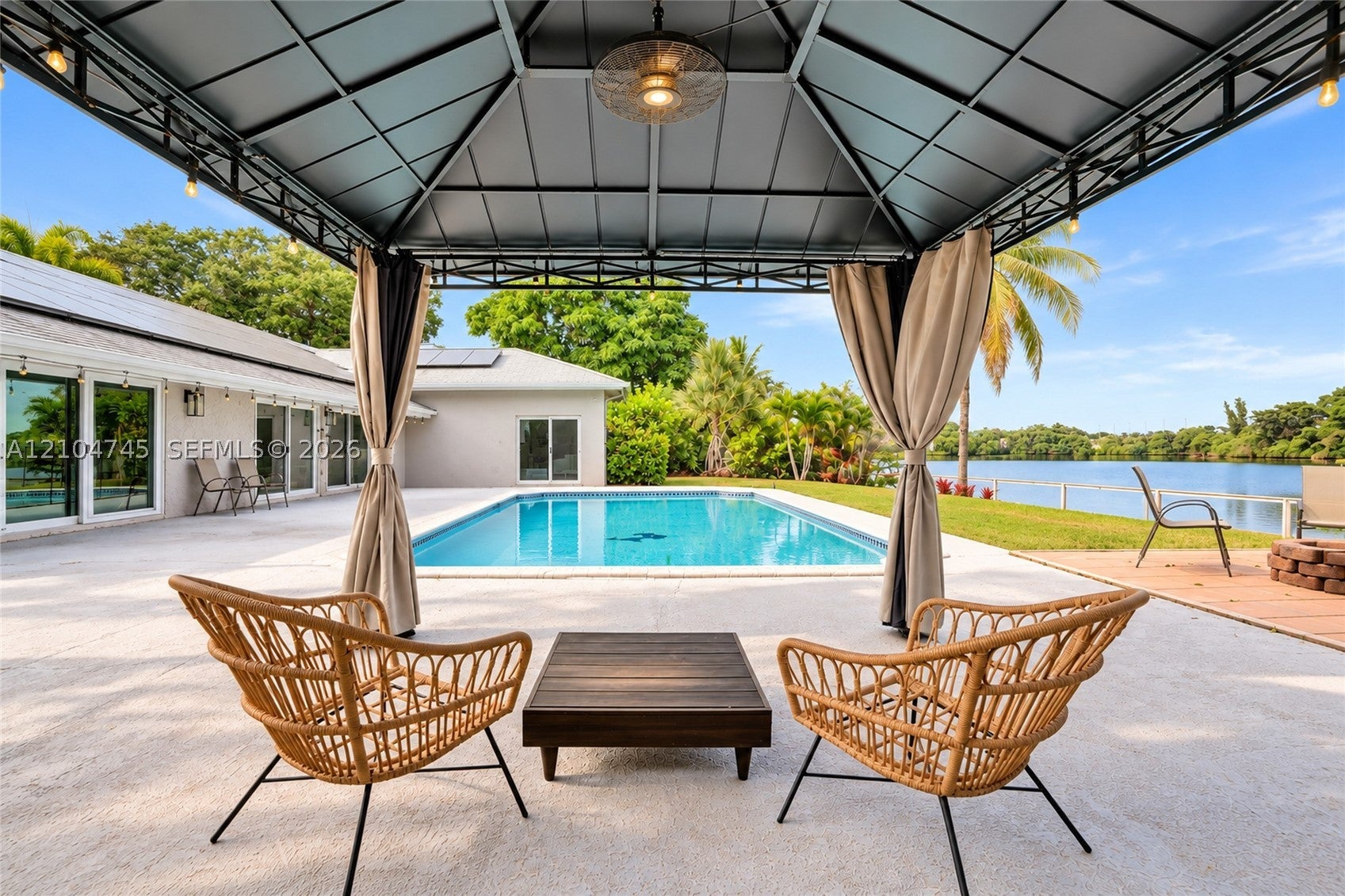
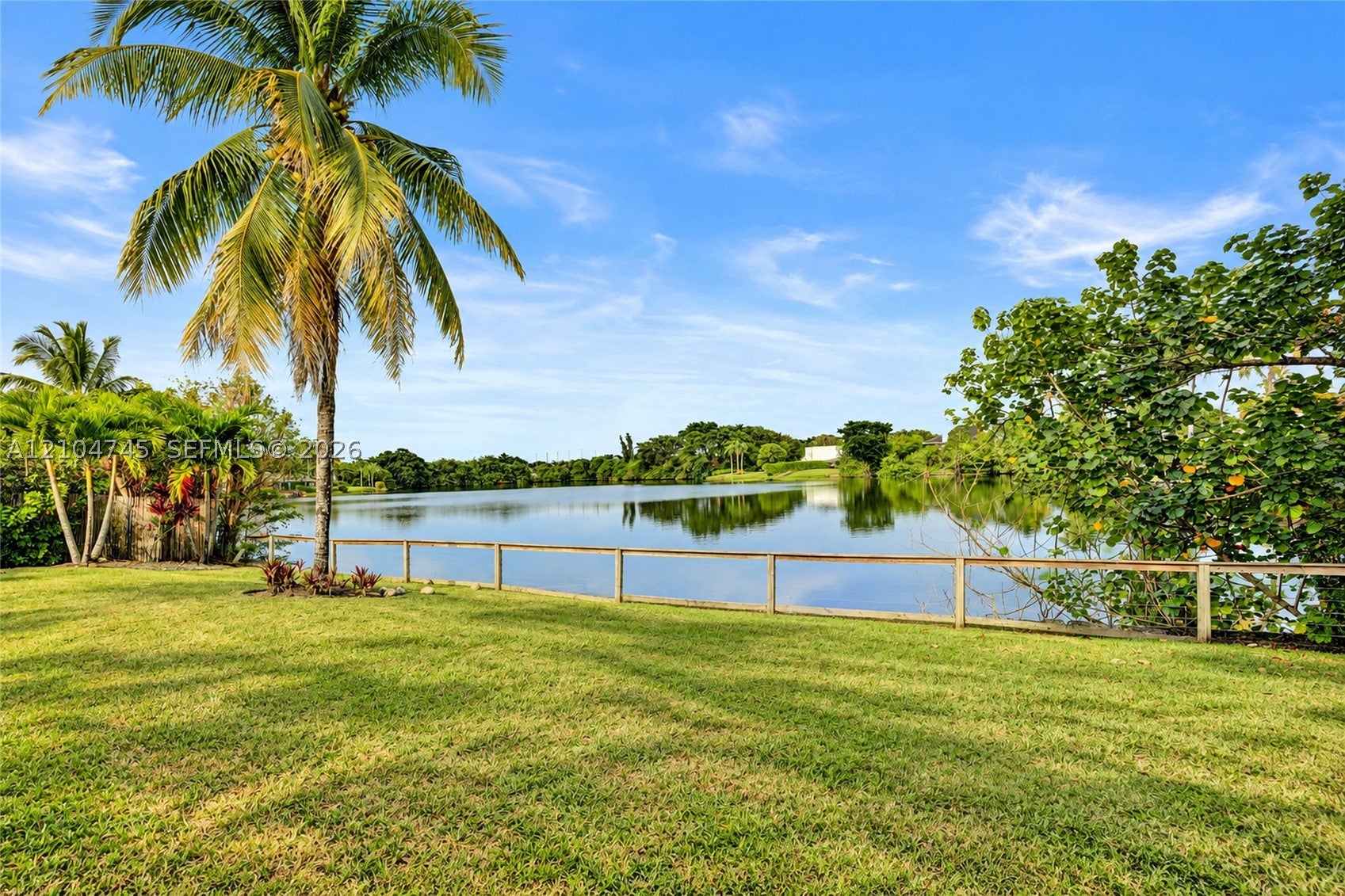
Out back, a fenced, heated in-ground pool sits beside a covered cabana, and the lawn rolls down to an open lake view framed by palms. It’s a backyard made for slow mornings and long weekends, with garden views on one side and water on the other.
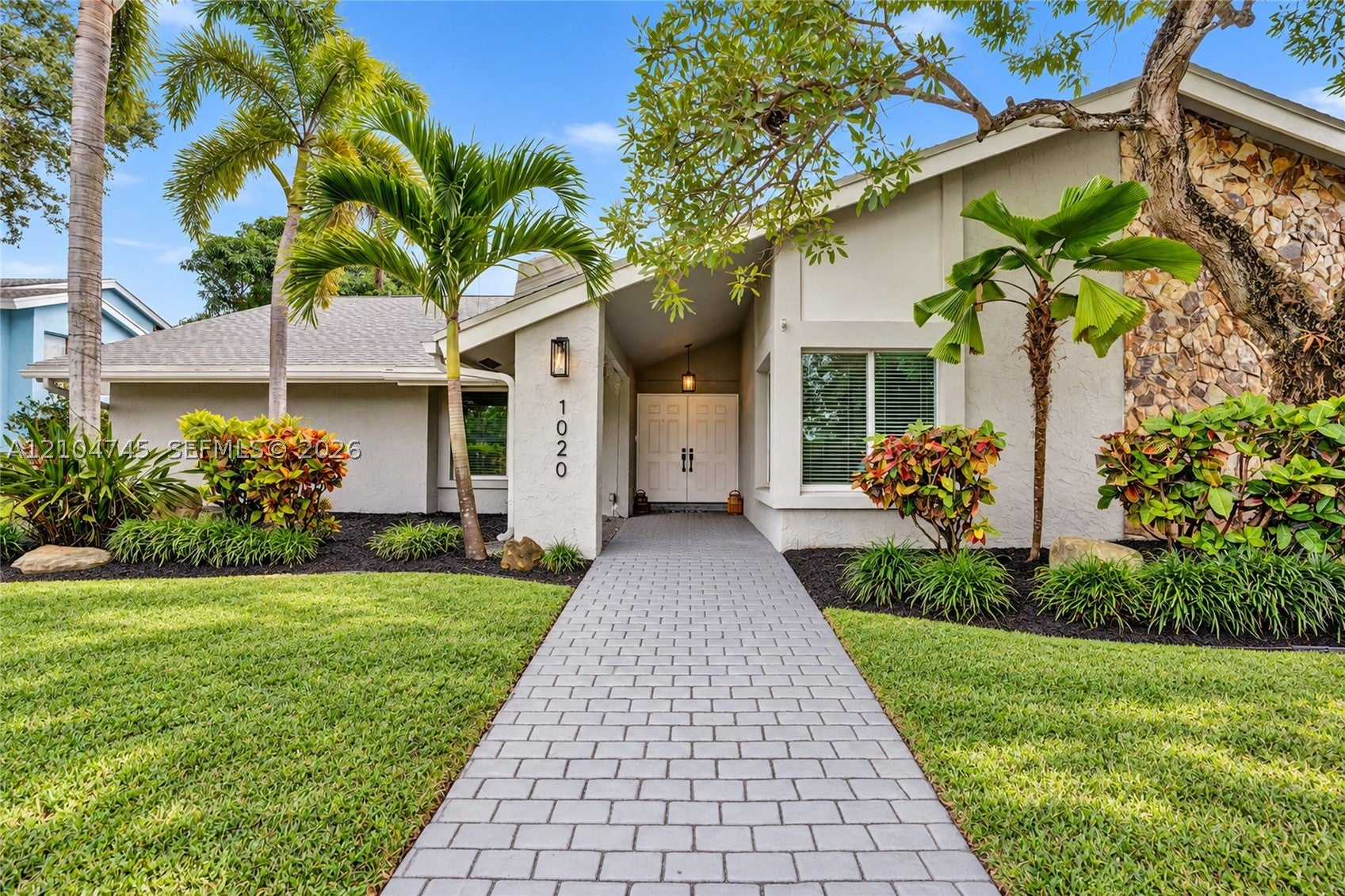
The lawn runs down to the lake.A paver walk leads to the front door.
The upgrades that matter
Roof replaced in 2021 (per the listing)
Impact windows and doors
Solar panels, fully paid off
Newer central A/C
Attached 2-car garage
Block construction, built 1978
Costs at a glance
List price
$1,350,000 (about $469 per sq ft)
HOA
$400 per year ($33.33 per month); no association purchase approval required, per the listing
Property tax (listed)
$16,875
Financing listed
Cash, conventional, FHA, VA
Pets
Allowed
The location
The house sits in central Broward near the Jacaranda golf area, a short drive from Sawgrass Mills, Broward Mall, Nova Southeastern University, I-595 and Fort Lauderdale-Hollywood International Airport, with the beaches within reach.
See this home on the map
The gold pin marks this home. Want to compare? Browse every active listing nearby on the map.
MLS# A12104745. Listing courtesy of Damelecia, Inc. Listing data comes in part from the Miami Association of Realtors, Realtor Association of Greater Ft. Lauderdale and South Broward Board of Realtors. Information is deemed reliable but not guaranteed and should be independently verified. Photos courtesy of the MLS. Price, status and details may change; see the live listing for current information.
New York and New Jersey send more movers to Broward County than any other state. In the IRS’s latest county-to-county figures (tax filing years 2022-23), about 6,350 people moved to Broward from New York and about 2,570 from New Jersey. Counting the New York City area on both sides of the Hudson, the total was roughly 8,200. Brooklyn, Queens, Nassau, Manhattan, the Bronx and Suffolk were the largest single sources.
If you are planning the same move, this guide covers the practical questions we hear most from buyers coming south.
Where in Broward to start
Our guides cover nine Broward cities, and they feel very different from each other.
All nine guides are on our Areas page, and you can browse current Broward listings on our home search.
Getting around, and getting back north
Most Broward commutes are by car on I-95, I-595, Florida’s Turnpike, I-75 and the Sawgrass Expressway. Rail exists but covers less ground than you may be used to. Tri-Rail runs north to south with stops in Fort Lauderdale and Hollywood, and Brightline’s downtown Fort Lauderdale station connects to Miami, West Palm Beach and Orlando.
For trips back to the New York area, Fort Lauderdale-Hollywood International Airport (FLL) is the closest major airport for most of the county. Miami International (MIA) and Palm Beach International (PBI) are both within driving distance, depending on which end of Broward you live in.
Insurance and flood zones
Insurance is often the biggest surprise for buyers from the Northeast. Before you settle on a price range:
Get a homeowners insurance quote on the specific address, not a general estimate.
Ask for the home’s wind mitigation report, or order one. Florida law requires insurers to offer discounts for qualifying wind-resistant features such as impact windows and roof straps.
Look up the FEMA flood zone. If a home is in a high-risk zone and you use a mortgage, your lender will require flood insurance. Even outside those zones, flood coverage is worth pricing.
Condo and HOA rules
Many Broward homes sit inside a condo or homeowners association. Read the rules and fees before you commit:
For a mandatory HOA, Florida law requires the seller to give you a disclosure summary before you sign the contract.
Condos follow a separate law. After the 2021 Surfside collapse, Florida added milestone inspections and structural reserve studies for many condo buildings three stories or taller, and those can lead to special assessments. Ask for the latest inspection, the reserve study and the meeting minutes.
Some associations must approve a buyer or a lease before closing. Ask how long it takes so it fits your timeline.
Taxes and homestead
Florida has no state personal income tax. Property taxes still apply, and they are reset based on the new owner’s assessment after a sale, so the seller’s current tax bill is not a reliable guide to yours.
If the home becomes your permanent residence, you can apply for a Florida homestead exemption. You must own the home and live in it on January 1, and the application is due by March 1 of that year with the Broward County Property Appraiser. Homestead portability only moves savings between Florida homes, so it does not apply to a home you are leaving in New York or New Jersey. Our portability guide explains how it works.
Selling up north and buying here at the same time? Tell us your timeline, and we’ll help you line up showings, inspections and closing dates so you can do much of it from a distance. Contact us.
Once both sides sign, the work shifts from negotiating to proving. Inspectors, lenders, title examiners and associations all get a turn. Most of their deadlines count from the same date, so a slow start can squeeze everything after it. This Broward escrow timeline follows the Florida Realtors and Florida Bar AS IS contract and uses the numbers that apply when its blanks are left empty. Your contract may set different numbers, so keep it open while you read.
What does escrow mean in a Florida home purchase?
In Florida, escrow is the holding period between a signed contract and closing. A neutral escrow agent keeps your deposit until the deal closes or ends. That agent is named in the contract. It is often a title company or a real estate attorney. A broker can also hold it in a trust account.
A closing agent runs the closing itself. Usually that is also a title company or an attorney. The closing agent orders the title work, prepares the final figures, collects the money and records the deed. The contract decides who picks the closing agent. Under the regional title option used in Broward, the buyer chooses.
When does the clock start?
Every count begins with the Effective Date. That is the day the last party signs or initials the final offer or counteroffer and delivers it.
The contract counts calendar days. If a deadline lands on a weekend or a national legal holiday, it moves to the next day that is neither. The contract also says time is of the essence. In plain terms, the dates are firm unless both sides sign a change.
When is the escrow deposit due?
The initial deposit either comes with the offer or goes to the escrow agent within a set number of days. If that blank is empty, you have 3 days after the Effective Date. If you agreed to an additional deposit, it is due within 10 days unless the contract says otherwise.
Florida’s real estate rules require a broker who receives deposit money to place it in escrow by the end of the third business day. When a title company or attorney holds the deposit instead, the broker for the agent who wrote the contract generally must ask in writing for proof that it arrived. Before you wire anything, confirm the instructions by phone at a number you already trust.
What can you do during the inspection period?
The default inspection period is 15 days. It is your window to look closely. Common choices include a general home inspection, a wind mitigation report and a four-point report on an older home. Your insurance agent can tell you which reports a carrier will want. Some buyers also add a termite inspection, a sewer scope or a pool check.
Under the AS IS contract, the seller does not promise repairs. You may cancel for any reason by written notice before the period ends, and your deposit comes back. If the period ends without notice, you accept the home’s condition. You also pay for the inspections and for any damage they cause.
If the home sits in a special flood hazard area and its elevation or flood insurance eligibility falls short, the contract gives a separate window to cancel. It is 20 days by default.
How does the loan approval period work?
If your purchase is financed, you apply for the loan within 5 days. The loan approval period is 30 days. The appraisal is part of that approval.
Before the period ends, send one of two written notices. Either you have approval, or you are satisfied you can get it and will close. If you cannot get approval after a good faith effort, you may cancel in writing before the period ends and get the deposit back. If you send no notice at all, the contract moves forward as if there were no financing contingency, and the seller gets 3 days to cancel.
Answer lender requests the same day if you can. Hold off on new credit, big purchases or a job change until after closing.
What does the title work cover?
The title commitment is due at least 15 days before closing, or 5 days for a cash purchase. It shows what the title insurer will cover and what it will not. You have 5 days after you receive it to raise any problem in writing. The seller then has time to fix it.
What if the home is in an HOA or a condo?
Some Broward communities ask buyers to apply for approval before closing. Start the application as soon as the contract is signed. Ask your agent for the association’s usual timeline and fees, and plan your closing date around them.
When do you see your final numbers?
For most home loans, federal rules say you must receive your Closing Disclosure at least three business days before closing. If the lender cannot meet that rule after your loan is approved and underwritten, the contract extends closing by up to 7 days. Compare the Closing Disclosure with your Loan Estimate line by line. Our Broward closing costs guide explains each charge.
What happens at the walk-through?
You or your agent may walk through the home the day before closing or on closing day, before you sign. The purpose is narrow. Confirm that the items in the contract are still there and that the seller kept the home in the condition the contract requires. Run the faucets, the AC and the appliances. Bring the contract’s list of included items.
What does a Broward escrow timeline look like?
These are the contract’s defaults when the blanks are left empty. Day 0 is the Effective Date.
When
What happens
Day 0
Contract fully signed and delivered
By day 3
Initial deposit to the escrow agent
By day 5
Loan application submitted
By day 10
Additional deposit, if any
By day 15
Inspection period ends
By day 20
Flood zone cancellation window ends
By day 30
Loan approval period ends
15 days before closing
Title commitment due
3 business days before closing
You receive the Closing Disclosure
Day before or day of closing
Walk-through
What happens on closing day?
You sign the loan and closing papers. The closing agent confirms the funds have arrived, pays everyone and records the deed. Unless your contract says otherwise, the seller hands over possession at closing.
What should you do after closing?
If the home is your permanent residence on January 1, apply for the homestead exemption with the Broward County Property Appraiser by March 1. Expect your tax bill to differ from the seller’s. A sale resets the assessed value to full just value on the next January 1. If you are moving from another Florida homestead, read our note on taking your homestead savings with you.
What else do buyers ask about escrow?
Can a deadline be changed?
Yes, but only in writing signed by both sides. A text or a verbal okay does not change the contract.
What if I miss a deadline?
It depends on which one. Missing the end of the inspection period or the loan approval period can cost you the right to cancel and get your deposit back. Talk to your agent before the date, not after.
Ready to start looking? Browse homes for sale or call the Melecia Johnson Team at (954) 980-0006.
Melecia Johnson, Florida licensed real estate broker, BK3251569, Damelecia, Inc.
General information, not legal advice. Contract terms vary. Read your own contract and ask a Florida real estate attorney about your rights.
Sources: Florida Realtors and Florida Bar AS IS contract (ASIS-7x); Rule 61J2-14.008, F.A.C.; Section 475.25, Florida Statutes; Regulation Z, 12 CFR 1026.19; Sections 193.155 and 196.011, Florida Statutes.
Your offer is accepted. Before you get the keys, you bring one more payment to closing. It covers your down payment and closing costs, minus credits. This note covers the Broward closing costs that usually land on the buyer, with one worked example.
What counts as a buyer closing cost in Broward County?
Closing costs are the charges to finish the sale and record your loan. Most fall into four groups.
Government charges: Florida taxes on the mortgage and county recording fees.
Title charges: title insurance, endorsements and your closing agent’s fee.
Lender charges: lender or origination fees, any points you buy, the appraisal and the credit report.
Prepaids and escrow: interest, homeowner’s insurance and a starting balance for future bills.
Your contract decides who pays what. Under the Florida Realtors and Florida Bar AS IS contract, each side pays its own closing services fee. Inspections and a survey are the buyer’s cost.
Who pays for title insurance in Broward?
Title insurance covers ownership problems a search can miss. The owner’s policy protects you. The lender’s policy protects the lender.
The contract lets the parties choose who pays. Option 9(c)(iii) is the regional option for Broward. Under it, the buyer picks the closing agent and pays for the owner’s policy, the lender’s policy and endorsements. The seller pays for the title search, up to $200 if that blank is left empty, plus the tax and lien searches. Check which option your contract uses.
Florida sets title premiums by rule. The owner’s policy is $5.75 per $1,000 of price up to $100,000, then $5.00 per $1,000 up to $1 million. On a $450,000 home that is $2,325. A lender’s policy issued at the same time is $25 when the loan is not larger than the price. Lenders usually ask for endorsements. The common Florida Form 9 is 10% of the two premiums. A lower reissue rate can apply if the seller’s owner’s policy is under three years old.
What taxes do you pay on a Florida mortgage?
Florida charges two taxes when a mortgage is recorded. Under the standard contract, the buyer pays both.
Documentary stamp tax on the note: $0.35 per $100 of the loan, with any part of $100 rounded up. There is no cap on a recorded mortgage.
Nonrecurring intangible tax: 0.2% of the loan, which is $2 per $1,000.
On a $360,000 loan, that is $1,260 in stamps and $720 in intangible tax. A cash buyer pays neither.
Broward County charges $10 for the first page and $8.50 for each added page to record your deed and mortgage.
What are prepaids and escrow at closing?
Prepaids are not fees. They are costs of owning the home, paid ahead at closing.
Prepaid interest: from closing day through the end of that month. Close on April 15 and you pay 16 days. Your first payment is June 1.
Homeowner’s insurance: most lenders want the first year paid at closing.
Escrow: a starting balance for future tax and insurance bills. The number of months depends on the lender and the closing date.
One credit helps. Florida property taxes are paid in arrears, with the bill sent in November. So the seller credits you from January 1 through the day before closing.
What extra costs do FHA and VA buyers pay?
An FHA loan adds an upfront mortgage insurance premium of 1.75% of the base loan, usually added to the loan. The annual premium on a standard-size 30-year loan is 0.55% with less than 5% down and 0.50% with 5% or more.
A VA loan has a funding fee instead. On first use it is 2.15% with less than 5% down, 1.5% with 5% or more, and 1.25% with 10% or more. Veterans who receive VA disability compensation are exempt. See our VA buyer page.
When either fee is financed, the mortgage taxes are figured on the larger loan.
What if you buy a condo or a home in an HOA?
The buyer pays the association application fee. For a condo, Florida caps it per applicant. The Florida Department of Business and Professional Regulation (DBPR) transfer fee notice posts the current cap, which it lists as $150. HOA fees vary. The seller pays for the estoppel certificate, which shows what the owner owes. That fee is capped at $299, plus more for a rush or a past-due account.
How much cash do you need to close on a $450,000 Broward home?
Here is one estimate: a $450,000 single-family home, conventional loan, 20% down, 30 years at a sample 7.00% rate, closing April 15, 2027. The buyer pays the owner’s policy. Lines marked sample are placeholders, not quotes. The tax credit uses a sample $7,800 tax bill for the seller, less the 4% November discount, times 104 days out of 365. That bill is the seller’s, so it differs from the 2% figure used for your payment.
Item (estimate)
Amount
Down payment, 20%
$90,000.00
Owner’s title policy
$2,325.00
Lender’s title policy
$25.00
Endorsements, Form 9 and ALTA 8.1
$260.00
Mortgage stamp tax
$1,260.00
Intangible tax
$720.00
Recording, deed and mortgage (sample, 18 pages)
$156.00
Lender fees and appraisal (sample)
$1,500.00
Inspections and survey (sample)
$800.00
Settlement fee (sample)
$450.00
Closing costs before prepaids
$7,496.00
First-year homeowner’s insurance
$6,100.00
Escrow, 3 months tax ($2,250.00) and 2 months insurance ($1,016.67)
$3,266.67
Prepaid interest, 16 days
$1,104.66
Prepaids
$10,471.33
Tax credit from seller, Jan 1 to Apr 14
-$2,133.57
Deposit already paid
-$10,000.00
Estimated cash to close
$95,833.76
The estimated monthly payment is $3,653.42: $2,395.09 principal and interest, $750.00 taxes and $508.33 insurance. Taxes use 2% of price and insurance uses $6,100 a year, the same planning figures as our mortgage calculator. Your real tax bill depends on the city and assessed value. Escrow uses the full $6,100 a year, so it can differ by a cent from the rounded monthly figure.
Under the standard contract, the seller pays the documentary stamp tax on the deed: $0.70 per $100 of price, or $3,150 on a $450,000 home. The seller also pays the estoppel fee, their own closing fee and the cost to record the release of their loan. Under the 9(c)(iii) option, the seller also pays the title, tax and lien searches. Real estate compensation is set by agreement. No rate is standard.
How do you protect your closing money from wire fraud?
Scammers send fake wiring instructions that look like they came from a title company or an agent. Before you wire, call your closing agent at a number you already know, not one from the email. If instructions change by email, stop and call. A sent wire can be very hard to get back.
What else do Broward buyers ask about closing costs?
Can the seller pay part of my closing costs?
Yes, if the contract says so. Ask in the offer. Loan programs set limits. VA caps seller concessions at 4% of reasonable value.
When will I see my real numbers?
Your lender sends a Loan Estimate within three business days of your application, and you must receive a Closing Disclosure at least three business days before closing. Compare the two.
Does a cash buyer pay closing costs?
Yes, but fewer. There are no mortgage taxes, lender’s policy, prepaid interest or escrow. The owner’s policy, deed recording and settlement fee still apply.
Is my deposit on top of the cash to close?
No. Your deposit is credited at closing.
Want a second look at your Loan Estimate? Call the Melecia Johnson Team at (954) 980-0006 or reach us through our contact page. Melecia Johnson, Florida licensed real estate broker, BK3251569, Damelecia, Inc.
Estimates only. This is not a Loan Estimate or a Closing Disclosure, and it is not legal or tax advice. Rates and fees can change. Ask your lender and your closing agent for your actual costs.
Sources: Sections 201.02, 201.08 and 199.133, Florida Statutes, and the Florida Department of Revenue; Rules 69O-186.003 and 69O-186.005, F.A.C.; Broward County Records, Taxes and Treasury fee schedule; Florida Realtors and Florida Bar AS IS contract; DBPR estoppel and transfer fee notice; Regulation Z, 12 CFR 1026.19; HUD Mortgagee Letter 2023-05; VA.gov funding fee page.
If you have a homestead exemption in Florida, you may be able to move your Save Our Homes savings to the next house. The Broward County Property Appraiser calls that portability. The cap is $500,000 of assessment savings. It is not a $500,000 payment.
Save Our Homes slows how fast the taxable value of a homesteaded home can rise. The gap between market value and that lower assessed value is the savings. Portability lets an eligible owner carry that gap to a new homestead in Florida.
The new homestead has to be in place within three tax years of the sale, or of the date you stop using the old home as your permanent residence. Before 2021, that window was two tax years. Florida voters extended it.
You can use portability more than once. The amount can change each time. It applies to a move anywhere in Florida, including a move that stays in Broward. It does not apply to a homestead you are leaving in another state.
New to Florida? Portability only works for a move from one Florida homestead to another, so savings from a home in another state do not come with you. If you buy in Broward after moving from out of state, you file a new homestead application with the Broward County Property Appraiser. You must own the home and live in it as your permanent residence on January 1, and the filing is due by March 1 of that year. When March 1 falls on a weekend, Broward moves the date, so check bcpa.net. To budget the purchase itself, see what Broward buyers pay at closing.
You do not have to sell the old house. You do have to stop claiming it as your permanent residence. You cannot hold homestead on two homes at once.
The exemption itself does not transfer. You file a new homestead application on the new home, and you file portability with it. On bcpa.net, the online homestead filing prompts for the portability form when a prior Florida homestead qualifies. The form is DR-501T.
The amount that moves is not always the full gap. A more expensive home and a less expensive home use different formulas, and shared ownership can split the benefit. The property appraiser calculates it. A sale price is not a tax bill.
For 2026, the Broward County Property Appraiser lists timely homestead filing from March 4, 2025 through March 2, 2026, and a late-file deadline of September 18, 2026. Check the year on bcpa.net before you count on a date.
If you are selling in Broward and buying again in Florida, ask what portability would do to the assessed value of the next house before you write the offer. See the property appraiser’s FAQ for the details.
As the events of the last few years in the real estate industry show, people forget about the tremendous financial responsibility of purchasing a home at their peril. Here are a few tips for dealing with the $$$ so that you can take down that “for sale” sign on your new home.
Get pre-approved
By getting pre-approved by your lender, you will save yourself the effort of looking at homes you can’t afford. You can also put yourself in a better position to make a serious offer when you do find the right house. Unlike pre-qualification, which is based on a cursory review of your finances, pre-approval from a lender is based on your actual income, debt and credit history. By doing a thorough analysis of your actual spending power, you’ll be less likely to get in over your head.
Choose your mortgage carefully
It used to be that the emphasis when it came to mortgages was on paying them off as soon as possible. Today, the debt an average person will accumulate due to credit cards, student loans, etc. means it may be better to opt for the 30-year mortgage instead of the 15-year. This way, you have a lower monthly payment, with the option of paying additional principal when your budget allows. Additionally, when picking a mortgage, you usually have the option of paying additional points (a portion of the interest that you pay upfront at closing) in exchange for a lower interest rate. If you plan to stay in your new home for a long time, paying the points will save you money.
Do your homework before bidding
Before you make an offer on a home, do some research on the sales trends of similar homes in the neighborhood with the help of your Realtor®. Consider sales of similar homes in the last three months. For instance, if homes have recently sold for more than the asking price and the listing is new to the market, your opening offer should probably be close to the asking price.
Not sure where to start? Call the Melecia Johnson Team at (954) 980-0006 and keep these tips in mind.